Showing posts with label fuel tank. Show all posts

Sunday, January 31, 2016

Fuel Tanks (Part 3)

Continued from Fuel Tanks (Part 2)

I followed the same basic process for the other side, but I sacrificed about 2.5 gallons volume in exchange for a good sump. I used a router to get close, then sanded the bottom of the tank into the shape I needed. The design I drew up will work equally well whether the plane sits on conventional gear or tricycle, because I like to keep my options open.

After sanding to shape, I laid up the fiberglass, allowing the first layer to cure before adding the second and hot coating. I had to make several incisions to get the cloth to lay correctly, as well as add a few patches of cloth in trouble spots. There were still a few voids left, so I used a syringe to fill those with micro. Hopefully the pictures below give you a good idea of the geometry involved, keeping in mind that the entire tank will be tilted 5" up at the outboard end. Therefore, the low area is at the inboard rear end of the tank area.


I added the (previously drilled and tapped) aluminum plate for the drain valve, as well as a thin aluminum plate where fuel from the transfer tank will be directed. The theory is that pressurized fuel could, over time, wear a hole through the fuel tank. Not sure how worried I really need to be about that, but it's an easy fix to a "what if."


After the spars were in place, I lifted the bottom in place and began cutting and fitting my baffles and braces. This time around, I managed to seal the corners without much difficulty. I taped the corners as pictured below, then used a long needle on a syringe to fill the resulting area from the bottom, which kept air bubbles from becoming trapped and leaving voids.


I fiberglassed a small door onto an aluminum hinge to hang over the opening to my sump area, which will allow fuel in but not out. Another copy from Mark Langford.


With the baffles in place, I made the ledges for the top the same as before.


Bottom went on, then leak tested. After the bottom was in place, I shaped the one-way door so it would cover the hole to the sump area.


Because of the angle the baffle is at, I used some flox and micro to build up the area and get a good flush fit between the hole and the door. To do this, I attached the door, used plastic and tape to keep the vinylester from sticking to the door, and then started filling the gaps on the sides and top with flox and letting that set. I used runny micro for the bottom, so I wouldn't end up with a lip that could trap contaminants until inopportune moments.


The result is a gravity powered one-way valve. I considered using actual fuel valves, but they would have become clogged if any debris made it into the tank. This design will allow debris to flow through, and then collect at the drain valve and be removed during preflight.


Notice that the top of the baffle that holds the one-way valve is open to the rest of the tank. That's because the line from the transfer tank will feed directly into the sump area. This way the sump/pickup area will always be the first place that gets fuel (which is really the only place that ever needs fuel.) When the sump area is full, fuel will overflow into the rest of the tank. If I leave the transfer pump on and the tank fills completely, the vent line will allow fuel to overflow back to the transfer tank instead of building pressure and causing damage.

Next I set my fuel filler neck in the top of the tank. I drilled holes in the sides of it to let the micro through in an attempt to keep the twisting force exerted on the fuel cap from twisting the filler neck free.


Lines in place:


Fuel level sender:


I attached the top of the tank, leaving the outboard end uncovered so any leaks will be easy to find and fix.


Upon pressure testing the tank, I discovered I had a major leak. So bad that no matter how much air I allowed into the tank, I couldn't get anything to register on my pressure gauge. I spent about an hour going over every inch of the tank, and I couldn't find a single spot that had even a tiny bit of air coming through. Well... *almost* every inch of the tank. It turns out the drain valve was in a spot that was difficult to reach in my crowded work space. Pro tip: if you're going to pressure test a vessel, make sure all of the holes you intended to make are plugged. Once I put the drain valve in its proper place, I had zero leaks, so this wing gets removed and put away for the winter.

After passing the pressure test, I attached the rest of the foam to the top. Wing tanks are finally finished, so I'll lay off the vinylester until the weather gets nicer. To give you an idea of the time penalties cooler temperatures incur, I'll say this: In October, the temperature outside was around 70 degrees, and if the sun was out I could expect a layup to cure in under an hour. With the heater on the fritz in the shop, the temperatures fluctuated from as high as 60 to as low as 30 overnight (although I made use of some stinking bright, stinking hot work lights to help.) I routinely leave a little extra vinylester from each batch in its mixing cup, to verify that it cured correctly, and there have been several occasions where that stuff didn't fully set for two whole days. If I had warmer temperatures, this process would have taken much less time. Henceforth, I'll be using this winter to accomplish anything and everything that isn't fiberglass related, and get that stuff done once it warms up outside.

Tuesday, November 10, 2015

Fuel Tanks (Part 2)

Continued from Fuel Tanks (Part 1)

After I cut my baffles to size and shape, complete with corners cut for fuel passage, I needed to fill the exposed corners with vinylester and micro so the foam would be sealed off from fuel contact. This was by far the most frustrating task, and took 5 or 6 tries to get right. A few things I discovered during the process:
1. Flox will not work for this.
2. See number one. Instead of trying to prove me wrong, just spend a week standing over your project cursing up a storm (you'll accomplish just as much). Then, use micro and do it right.
3. Micro doesn't work well either. 

Honestly, I have no idea how to do this simply and effectively. Sometimes it worked, sometimes it didn't. However (on to actual discoveries):
1. Vinylester, when exposed to the sticky side of duct tape, cures with a thin sticky film. This is not necessarily a problem, provided you can remove the film and still have a sealed corner.
2. Wax paper *must* be removed before vinylester fully cures, or you will be sanding it off.
3. Cling wrap: same story. 

Part of why I had so much trouble was that I desperately wanted to do all four corners in one batch, so I was coming up with creative ways to channel micro into all four corners without any spilling out. This was *so* ineffective, I spent a week on it and had to resort to doing one corner per baffle per batch. 

As soon as my baffles were sealed, I floxed them into place in the wing. I had a bit of extra flox, so I went ahead and attached my fuel level sender to the tank wall at the same time. I wasn't worried about making the sender removable, since I'd have to do serious damage to the wing in order to replace it anyway.


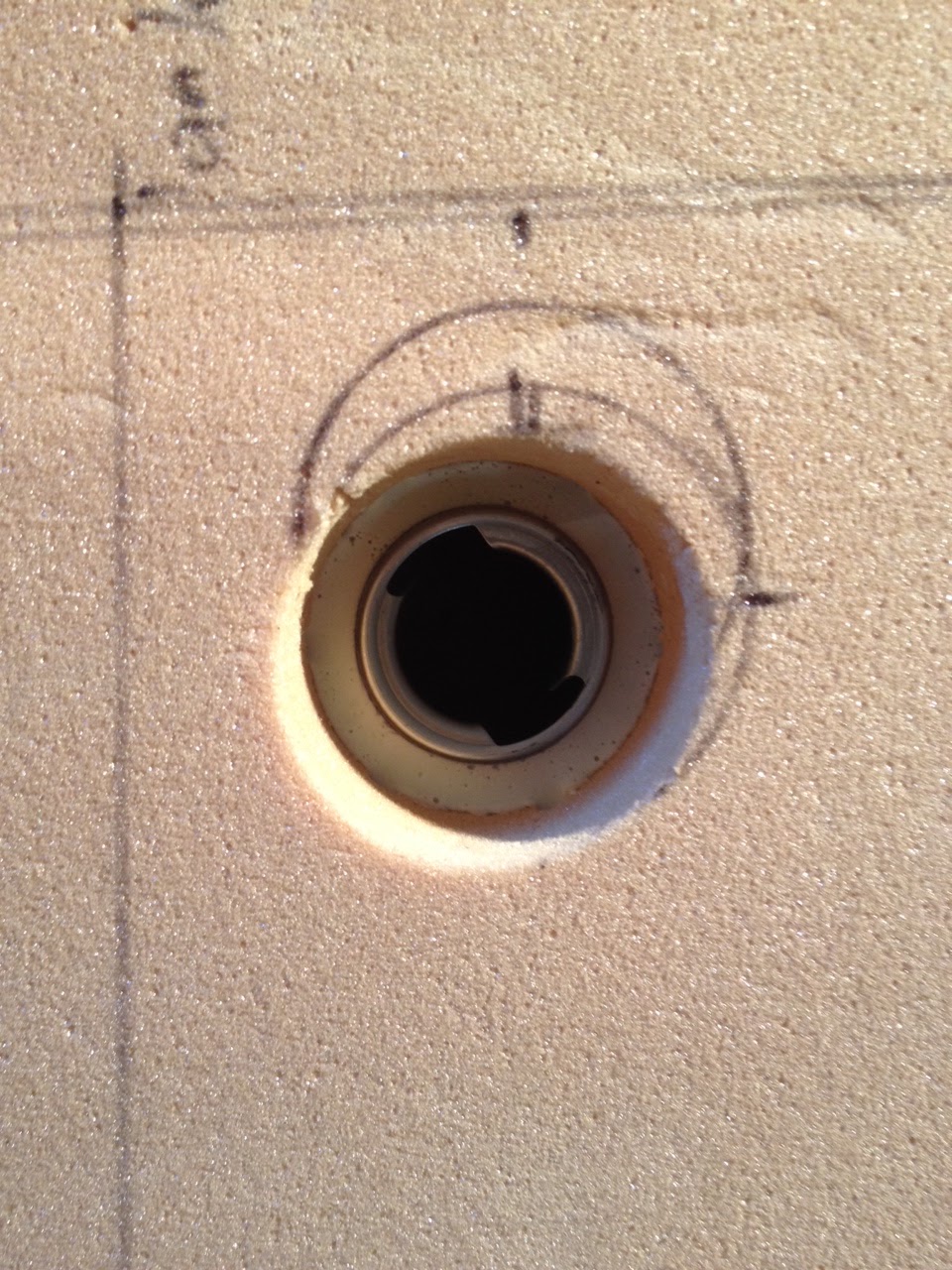
My next step was to figure out where to put my drain valve. Had I thought a little more about it, I could have easily built a proper sump into this tank; I've done that for the other side. However, this side has no sump at all, so I had to fill it with water and then use a shop vac to suck water out until I could see where the lowest point was. I then popped the bottom out and floxed my drain valve plate in. I had previously drilled and tapped the aluminum plate, and I positioned it as far down in the foam core as possible to give it the best chance of trapping contaminants and water. (picture was taken after lines were run)


I cut and sanded the top of the tank to shape, used duct tape as a release agent, and floxed it onto the baffles in the same way I did the bottom of the tank. After the flox cured, I removed the top and cut a hole for the filler neck. I'm using a standard 1.5" cam style filler neck, because it's several hundred dollars cheaper than the aircraft version. Also, replacement parts are widely available, as they have been since motorcycles and tractors began using this style filler neck in the who-knows-whens.


I also began running my aluminum lines. The left tank is just a holding/transfer tank, so it only needed a pickup line and a vent/return line. Once the lines were flared/attached/floxed in place (as well as the filler neck), the bottom went back on, this time permanently.


After curing, I filled the tank (as much as I could) with water for a preliminary leak test. After leaving it for half an hour, I saw no evidence of water leaking through the foam cores. I utilized my drain valve to remove the water, then give my tank an extra day in the warm garage to dry out. I noticed a few potential pinholes in one of the side walls, which I promptly spent half an hour deciding whether or not I wanted to fix (with the other option of hoping it wasn't actually a leak presenting a pretty solid case in my head.) While debating with myself, and lamenting that I couldn't pressure test the tank until the top was fixed permanently in place, I came up with a simple way to pressure test spots I wasn't sure about. All it takes is a suction cup. Stick it on, and if it falls off there's a leak. So I picked one up, and started trying my method out. Turns out suction cups won't stick to areas without pinholes, either. The only way I was able to find pinholes was visually. I did find a large number, but patched them without much trouble.

One thing I don't see addressed very clearly is bonding procedures for fueling composite aircraft. As best as I can find, the main concern is that fuel sloshing in composite tanks causes a large amount of static buildup on the surface of the fuel. In order to equalize the charges between the fuel surface and the fueling apparatus, the bonding/grounding strap has to indirectly contact the surface of the fuel. I decided that the aluminum fuel lines, which will be in contact with the surface no matter how much fuel is in the tank, were perfect for bonding. The anodized fittings don't impede the conductivity (surprisingly) so I can just attach a wire to the outside fuel lines and run that wire to a common bonding point.

I also floxed a short piece of fuel line to the top of the tank right next to and visible through the filler neck, which hangs down to the 10 gallon fill level. During the first phase of flight testing, I'll fill the tank to this point to match the 10 gallons the other side holds when full.


 Finally, I floxed the top into place.


I blew compressed air through the vent lines periodically while the flox cured to make sure no extra flox clogged my lines.

After allowing a day for curing, I plugged the lines and performed a pressure test on the tank. Naturally, it failed. I believe the flox began curing before the top was fully in place, and I had 4 places air leaked out, all of them at the top of the tank. However, I still had access to all four points, and was able to mix up a runny micro slurry to pour in and around the leak areas. Further testing revealed no leaks, so I removed the wing and set it aside. I'll follow (mostly) the same procedure for the other side.

Continued in Fuel Tanks (Part 3)

Monday, October 12, 2015

Fuel Tanks (Part 1)

I'm not a fan of the header tank location in the plans. Between COG shift, quantity constraint, and location, I've elected to build my tanks into my wings instead. I'll be using my outboard wings, because the inboard wings have aileron cables and landing gear in the space I'd want to use. The outboard wings also have dihedral, which will give me a definite lowest point in each tank. This makes it easy for me to locate my sump drain and fuel pickup.

Again, I'm borrowing very heavily from Mark Langford's fuel system, which you can find at his website.

After my wing spars were attached, I was able to begin by cutting slabs of foam for the top and bottom of the wing. I cut templates for the inside of the wing out of 1x4s, glued the 1x4s to the foam, and sanded the foam to the contours. (Note: After doing this for the transfer tank, I decided to do something a bit difference for the other side. See Fuel Tanks (Part 3) for what I think is a better setup.)

I made a bit of an error during my next step. Vinylester is touted as fuel resistant, and therefore, the best fuel tank resin. Unfortunately, not all vinylesters are created equal, and most manufacturers aren't willing to specify if a given vinylester is "fuel safe." As far as I can tell, it's due to the ethanol that winds up in gasoline today. I purchased vinylester from FGCI, went through the process of laying up my fiberglass, and as it was curing I bothered reading the pamphlet that came with it. "Not recommended for fuel." Guess I'll be adding another layer once I get more vinylester, which I ordered from Aircraft Spruce (sold specifically for fuel tanks).


Once the correct vinylester arrived, I began re-doing my layups. At first, I was laying up entire pieces of foam, then cutting them to shape. But I then realized I was wasting a lot of fabric and resin that way due to the dimensions of the foam. I began drawing the shapes I needed onto the foam first, then cutting fabric slightly larger than necessary and laying up. I finished the pieces I needed for my left wing tank, which is only a holding/transfer tank, then began installing them into the wing. My process is as follows:

1. Draw lines ⅜" down from the top of the inside of the spars, and ⅜" up from the bottom
2. Flox and attach front and rear tank walls to front and rear spars, using previously drawn lines
3. Apply duct tape to the tank bottom (to keep from attaching the bottom permanently at this time), then use tape and supports to hold the bottom in place
4. Use flox and fiberglass tape to build a ledge for the tank bottom to attach to
5. Attach tank sides and baffles using flox, taking care not to attach them to the tank bottom
6. Mark location for tank sump
7. Remove tank bottom, secure tank top in place (with duct tape where tank seams will be)
8. Build ledges for tank top as in step 4
9. Remove tank top, apply flox to tank bottom, and secure tank bottom in place permanently
10. Install all lines and fuel level sender
11. Fill with water for a leak test

Assuming the leak test doesn't reveal any catastrophic leaks, I'll fix anything that needs fixing and then install the tank top the same way I installed the tank bottom. The final leak test will be a mild pressure test; at this point if it fails, I'll have to cut open the tank from the top and try to find the failure.

For my fuel and vent lines, I cut ⅜" aluminum plates and drilled and tapped them for AN fittings. Next I cut away the foam where I wanted the lines to pass into the tank and floxed the plates in place.


 After I attached the front and rear tank walls to the spars, I got ready to lift the tank bottom in place. I attached five pieces of painter's tape with some slack, thinking they would support the bottom.


 As you can kind of see from this picture, five was not enough. However, eleven plus two of my spar-setting jacks was enough. (The funky glare is from four work lights I was using to keep the panels and fresh vinylester warm enough to cure well.) I'm scrambling to finish my fuel tanks before the weather gets too cold.


Continued in Fuel Tanks (Part 2)